Before the Film Western: The Frontier on Stage
Stage melodrama offered film Westerns a compact way to make frontier places and conflicts legible. Learn how to spot those shared theatrical conventions.
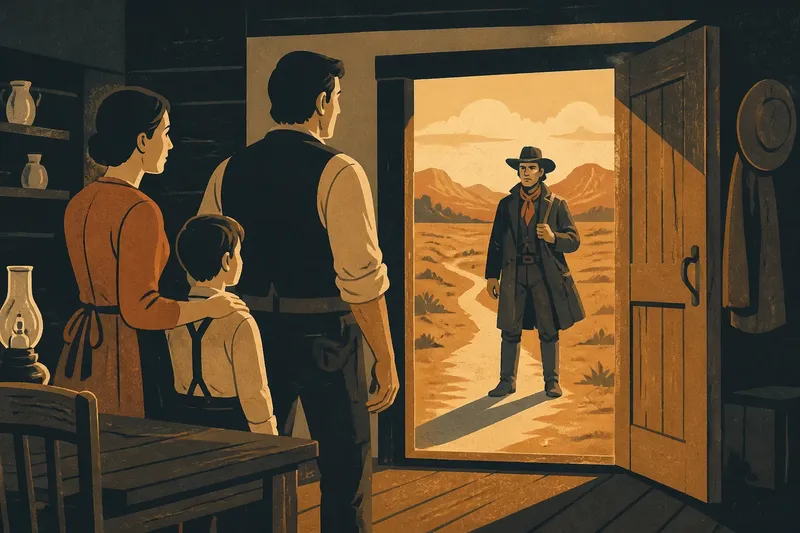
Stage melodrama offered film Westerns a compact way to make frontier places and conflicts legible. A cabin doorway, a distant ridge, and a traveler arriving with urgent news could make a theater audience understand where danger lay without showing an entire frontier.
That resemblance does not establish a simple line of direct influence from every stage production to every Western. It is more precise to compare conventions: both forms could use recognizable settings, sharply defined conflicts, and consequential entrances to guide an audience through a story.
How could stage scenery suggest a frontier?
A touring company had to make scenery workable within the limits of a theater and its available materials. Painted cloth, flat wooden pieces, practical doors, and a few movable objects could suggest a cabin, trail, or settlement without reproducing a landscape in detail.
A painted backdrop might imply mountains or open country, while a table and doorway gave actors places to gather, hide, enter, or leave. Like a folding screen in a small room, a few panels could suggest a change of place without building a complete world.
The scenery’s spareness also left room for meaning to shift. A cabin could represent refuge, a family’s claim to remain, or the point where private life met public conflict. A trail might signify isolation in one scene and the arrival of help or danger in another.
Which melodramatic roles made conflict readable?
Melodrama often organized a story around visible pressures and choices. A threatened settler, a loyal companion, an authority figure abusing power, or an uncertain stranger gave an audience recognizable positions within a conflict. These are broad character functions, not evidence that every play or Western used the same roster.
Costume and gesture could help make those positions legible. A work-worn coat, polished uniform, or conspicuous disguise offered clues before a character spoke; a pause at a doorway or a refusal to abandon someone made a stance visible across the theater.
Such roles could still change as a story unfolded. A protector might hesitate, while a suspected outsider might act with restraint. The useful comparison with screen Westerns is not that characters remained simple, but that familiar types could give an audience an initial point of orientation before behavior complicated it.
How did theatrical space make distance matter?
A stage could not show every mile between a settlement and open country. Instead, entrances, exits, and reports could make the distance consequential: someone returning from beyond the visible set might bring news, and a character leaving through a door could turn an argument into a pursuit.
These movements focused attention on thresholds. The audience could see who was allowed inside, who controlled a room, and who remained outside. A doorway thus served as more than scenery; it marked boundaries between shelter and exposure, or belonging and exclusion.
Sound and timing could suggest events beyond the visible set. A distant call, a sudden silence, or a pause before an entrance might encourage anticipation, but that is best treated as a comparison of dramatic techniques—not proof of a direct historical transmission to film. Screen Westerns could use similar suspense while adapting it to the camera and the locations available to a production.
What changed when Westerns moved to the screen?
Film could show actual terrain and move between close detail and broad landscape. Yet audiences still benefited from clear cues about where conflict gathered and what a place meant to the people in it. A cabin, ridge, trail, or settlement could be introduced plainly, then revisited after the stakes had changed.
The camera also altered performance. A gesture designed to read from the back of a theater could become smaller in a close view. A landscape could replace painted scenery with open distance, while making a cabin seem exposed to the country around it.
These similarities support a careful claim: theatrical conventions provide one useful lens for reading Westerns, but resemblance alone cannot show that a particular filmmaker borrowed from a particular play. Look at what each scene does with its space, movement, and characters before making a claim about its history.
What clues help you spot theatrical conventions?
Which details make a setting easy to read?
Notice a small group of scenic features that identifies a place without describing all of it. A cabin door, rough table, and backdrop suggesting distant country may establish a scene’s function before the dialogue does.
How does an entrance alter the scene?
Ask what an arrival interrupts or changes. If a newcomer brings news, a claim, or a challenge, the scene makes movement across a threshold carry the pressure of events beyond the visible setting.
What does costume suggest before a character speaks?
Consider whether clothing signals work, authority, disguise, or social distance. Then compare those clues with the character’s actions; a mismatch may complicate an initially familiar role.
When does a place take on a different meaning?
Track how the same location feels as its occupants or circumstances change. A room that first appears protective may become confining, while open country may feel exposed when a character has nowhere to hide.
How can a single scene reveal the comparison?
Say you are reading an invented Western scene with these starting details: a family waits in a cabin, a traveler approaches on a visible trail, and the door is the only clear entrance. First, note that the cabin and trail establish shelter and exposure; then watch as the traveler enters carrying news that makes staying dangerous.
The resulting reading is specific: the doorway changes from a boundary protecting the family to the route by which outside conflict reaches them. That observation identifies a shared theatrical convention—space and entrance organize the drama—without claiming that the scene copies a particular stage production.
For the same reason, the search phrase stage melodrama and film Westerns is best approached as a comparison of methods, not a claim of universal descent. Ask what a scene makes one room, one arrival, or one visible stretch of country do, and separate that observation from any claim about documented influence.
Why is the stage comparison useful?
Stage melodrama offers a way to notice how a few spaces, character positions, and movements can make a frontier conflict understandable. Those conventions can be compared with screen Westerns without treating the theater as a rigid blueprint or assuming a direct source for every familiar scene.
The distinction matters because resemblance and historical evidence are not the same thing. A close reading can show how a Western uses a doorway or an entrance; establishing a particular line of influence requires evidence beyond the scene’s visual or dramatic similarity.
When you encounter a cabin, ridge, or arrival that seems theatrically arranged, begin with the visible work it performs. That keeps the comparison grounded while leaving room for the screen Western’s own landscapes, camera choices, and changing characters.