Why the Main Street Frames a Western Showdown
Why the main street frames a Western showdown: see how storefronts, distance, and open sightlines turn a town street into an active force in the scene.
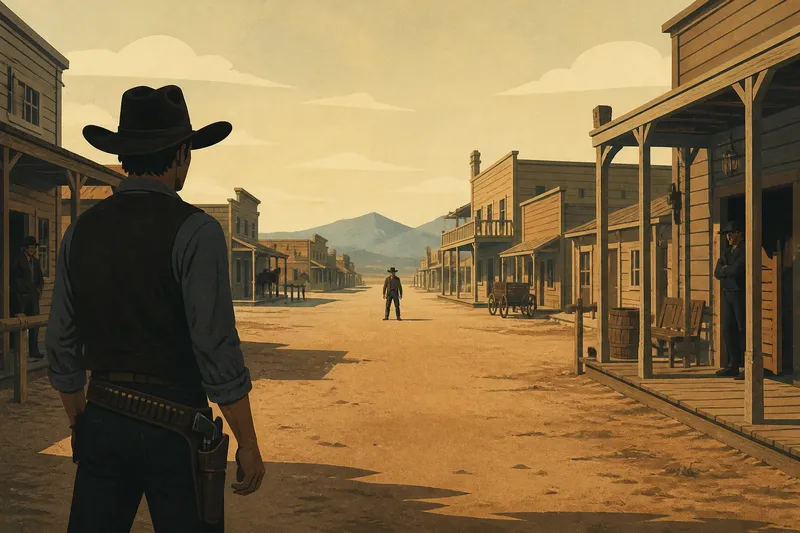
A Western’s main street turns a showdown into a visible arrangement of people, buildings, and distance. Its straight, exposed run lets the audience read who stands where and what separates them, so the town becomes part of the confrontation rather than a neutral backdrop. The street’s power lies in how it frames choices: where to appear, where to wait, and how much open ground to cross.
1. The street gives the confrontation a readable axis
A straight street creates a strong line through the frame. Buildings recede on either side, and the opposing figures can occupy different points along that line. Even before anyone moves, the composition establishes direction: one person faces another, while the town seems to funnel the space between them.
This clarity matters because a confrontation depends on relationships that can be hard to convey in a crowded setting. A doorway, a hitching rail, or a wagon can mark a position without interrupting the overall view. The audience can keep track of the distance between the figures and understand when that distance changes.
The arrangement resembles a ruler laid across a table: the object does not force anything to happen, but it makes spacing easy to judge. In a Western street, that legibility gives a pause or a small step more weight. The frame allows stillness to carry information.
2. Open ground makes distance part of the action
The unbuilt center of the street is not empty in dramatic terms. It is a stretch of space that someone might cross, refuse to cross, or use to keep another person exposed. When figures stand far apart, the gap becomes a visible condition of the encounter rather than an abstract idea.
That gap also shapes the audience’s attention. A distant figure can remain small against the storefronts, yet the street keeps that figure in view. The shot holds both the person and the route between the people, giving the viewer time to consider movement before it occurs.
Imagine a scene in which one character waits outside a general store while another appears at the far end of the block. If the camera keeps the full stretch between them visible, the expected result is a clear sense of exposure: neither person can approach unnoticed, and any movement across the open ground becomes easy to read. The street has made distance observable.
3. Storefronts create positions, not just scenery
Rows of facades divide the street into useful visual stations. A porch offers shade and a boundary; a doorway can partially conceal someone; a window can put an observer behind glass. These details give characters places to occupy while preserving the street’s broad line of sight.
Such positions also make the town feel inhabited, even when the frame contains few people. A sign, a bench, a hitching post, or a swinging door implies ordinary activity that the confrontation interrupts. The conflict has entered a working place, not a blank stage built solely for danger.
Directors can use the buildings to modulate visibility. A figure standing in a doorway may be distinct from the bright street, while someone crossing the sunlit center is fully exposed. The contrast makes the edges feel like possible shelter and the middle feel like a public declaration.
4. What does the street let the audience see?
Why do Western streets often look unusually straight?
A straight street gives the frame a clear direction and helps viewers compare positions across the town. It also makes the visible route between characters easy to follow, even when the scene holds on a wide shot.
How do porches and doorways change a showdown?
They give characters partial cover and distinct places to stand without removing them from the street’s larger composition. A doorway can suggest concealment, while a porch can place someone in view but apart from the open center.
Why might a director keep both characters in one shot?
Keeping both figures visible preserves their relationship to each other and to the ground between them. The audience can notice a shift in posture or position without losing the spatial context.
What changes when the camera moves closer?
A closer view can make a face or gesture more prominent, but it may hide the street’s full arrangement. Cutting between close shots can heighten uncertainty; returning to a wider view restores the geography of the encounter.
5. Camera placement turns geography into judgment
A camera positioned along the street’s axis can make the town appear to compress toward a distant point. The buildings seem to close around the open ground, while the figures remain aligned within the same visual corridor. From an oblique angle, by contrast, storefronts and posts may divide the space into separate zones, making the street feel less like a single channel.
Neither view is automatically more dramatic. The choice determines what kind of information the audience receives. A broad, centered view emphasizes the public arrangement; a side view can make one person seem screened by the architecture or isolated from the other.
Editing changes the emphasis again. A cut from a wide view to a hand, a face, or a doorway narrows attention to one detail, while a return to the wide shot reconnects that detail to the street. The setting remains active because each change in scale alters what is visible about the confrontation.
6. Town activity makes the street feel vulnerable
Small signs of everyday life can make an exposed street more than a duel-shaped corridor. A horse shifting near a rail, a curtain moving behind a window, or a door opening at the wrong moment suggests that the town has routines and witnesses. The encounter takes place among ordinary uses of space.
These details can also make stillness feel charged without requiring constant movement. A street kept nearly empty can imply that people have withdrawn indoors; a few visible townspeople can make the same open ground feel watched. The difference comes from how the film uses the edges of the frame, not just from the central figures.
For a viewer, the useful question is not only who faces whom, but what the composition permits each person to see. Can one figure watch a doorway while remaining in the street? Does a building interrupt a line of sight? Does the open center make retreat conspicuous? Those questions reveal how the town helps organize the encounter.
7. The street makes public exposure part of the conflict
A main street belongs to the town, so a confrontation there carries a public quality. The facades and open windows create the possibility of witnesses, while the central space leaves little room to disappear. Even if the scene includes only a few visible characters, its layout suggests that the event is happening in a shared place.
That publicness distinguishes the street from a secluded landscape. A ridge or empty plain may emphasize isolation; the town street places danger beside shops, porches, and routes people use. The built surroundings make the conflict feel like a disruption of civic order, not merely an encounter between two individuals.
When watching a Western, follow the street’s sightlines as carefully as the characters’ expressions. Notice who occupies the porch, who remains in the center, and which gaps the camera keeps visible. The main street frames a Western showdown by turning location into readable pressure: every position, crossing, and line of sight belongs to the scene.